





Directing overseas operations and implementing management reform. Marketing and human resource development secrets that strengthen our company.
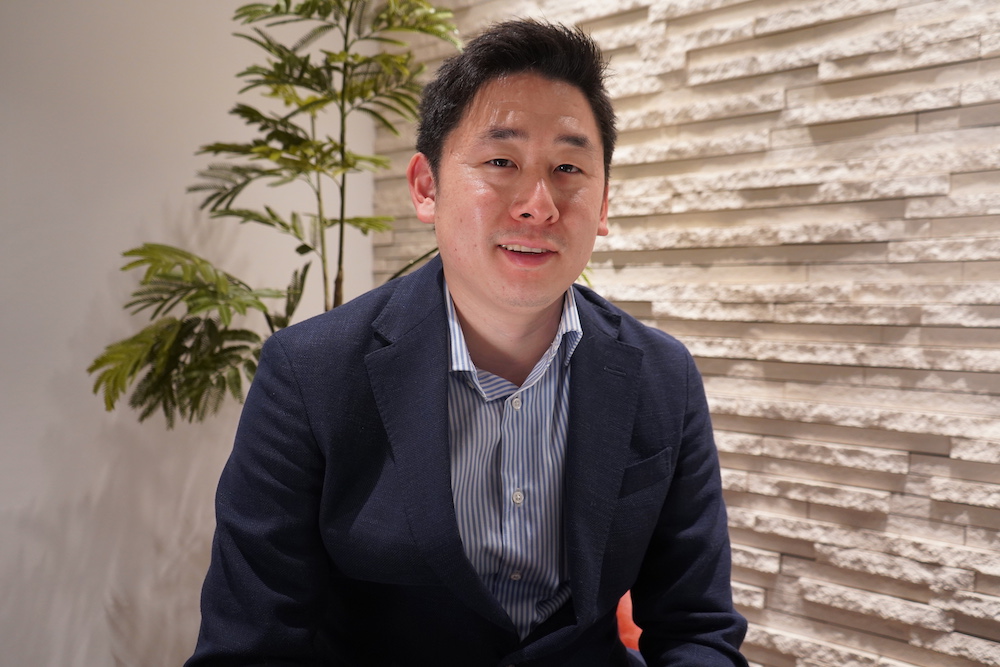
Profile of Yusuke Shinchi, Sync Logistics’ Eastern Japan Area Manager
After graduating from Tama University’s School of Global Studies in March 2013, he went to Taiwan to study Chinese but left after 3 months. After traveling around Southeast Asia, he joined an online travel agency in Beijing. Four months after joining the company, he was appointed Supervisor of Customer Service. He joined Sync Logistics in April 2016, and was appointed Eastern Japan Area Manager in April 2019, managing the Corporate Planning Office, the Overseas Business Department, and Human Resources.
Sync Logistics Appreciated my Experiences that Could Not be Conveyed in a Resume
I’ve been interested in foreign countries since my teenage years. When I was in high school, I went to America to study, and for college, I chose a university that focused on languages. By the time I graduated, I was already fluent in English, but after graduating I went to Taiwan to study Chinese which I thought I needed to become a global person. However, unlike English, I struggled in learning Chinese and gave up after 3 months (laughs).
After that, I travelled around Southeast Asia for more than a year. I then joined an online travel agency in China, acting as the supervisor for customer service. I thought I could learn Chinese by studying while working in China, but unfortunately, I didn’t have the opportunity to use my Chinese at work. Eventually, I had to return to Japan because I could not renew my visa.
After returning to Japan, I looked for a job that would let me travel overseas, and I came across Sync Logistics at a job hunting website. I applied for a job rather casually, then went to the interview. I was interviewed straightaway by the president himself, and unusually for a Japanese company, he appreciated my various experiences abroad which I couldn’t completely convey in my resume.
Honestly speaking, I did not understand their business at the time, but I decided to join the company because I thought if I joined this particular company, my unusual background would work positively for the company.

Becoming the Eastern Japan Area Manager within the Third Year of Joining the Company
When I joined Sync Logistics in 2016, it was shortly after the company branched into the Kanto area from Fukuoka. I was assigned to the Kawasaki office, but for the first 3 months, I was at the head office in Fukuoka for on-the-job training and learning the basics of the business.
However, a Sri Lankan employee who joined the company at the same time quit, so I was suddenly put in charge of all Sri Lankan-related sales, marketing, and operations. I didn’t really know what I was doing, but the president of our local agency in Sri Lanka was very kind and taught me many things as I mastered my job.
For the first 3 years, I was mainly doing Sri Lanka-related work, but after the company hired a Sri Lankan employee, that person gradually took over my work. I then took over work on the corporate side such as the Overseas Business Department, corporate planning, human resources, and hiring. I now oversee all operations at the Kawasaki office.
Building Relationships with Customers, and Creating Something from Nothing
Now we have one Sri Lankan, and one Mongolian employee, and two interns at the Overseas Business Department, each of whom has different duties. I am mainly in charge of marketing and sales in each country, concentrating on creating systems for the services we provide to our customers (used car exporters), and on building relationships that will make our customers continue choosing our company.
Specifically, we are taking about 20 Sri Lankan customers to Mongolia to help them build local connections and develop new business. If more of our customers start exporting used cars to Mongolia, they will consign transport services to us, which will be beneficial to them and to us.
Also, for customers who cannot maintain a branch abroad, they can consign all administrative procedures necessary for local transport to us. They can leave each country’s complicated administrative procedures to us and concentrate instead on procuring and selling used cars in Japan.
I believe that marketing is about creating something from nothing, and nurturing what is created into something bigger. The key to this is continuing to provide value-added services without getting caught up in simple price wars. Because our customers’ needs diversify year-on-year, we are committed to providing detailed, tailor-made services.
Even though Sri Lanka and Mongolia are both in Asia, business customs greatly vary from country to country. Quickly grasping such variations is a major point in expanding business in overseas markets.
Reforming Management Methods has Changed Staff Members’ Mindsets
With our company’s reorganization about a year ago, we have been reviewing our operations processes and management methods. This reorganization coincided with the spread of COVID-19, and many employees began working from home, which made it unclear whether they were doing their work soundly.
Up until then, each person’s tasks, including mine, were not being handled in a managerial way, and overall awareness of management was low. Working from home brought these issues to light, so we started managing each person’s work on a weekly basis, and checking progress during a weekly meeting.
I’m not the type to stick my nose into my subordinates’ work, because honestly speaking, I find it tiresome. Also, it’s not easy to enforce Japanese-style rules on non-Japanese staff. However, as we were expanding, there was a concern that work wouldn’t proceed smoothly if things stayed the same, so I was determined to make the change. It was difficult for the staff, but the weekly style of managing work has taken root, and I can feel that things are getting better.
Above all, each person’s mindset has changed, and their autonomy has improved. If the me of last year could see the company today, I would be surprised, for the company has changed in a good way.
No Instructions on How to Work, but Communicating in a Careful Way
For the past six months, we have been implementing team leadership strategies wherein the leader takes the initiative and does their best. Both foreign staff members and interns have grown a lot under these strategies. I am actually happier with their success than my own work.
When I train staff members, I am conscious about not specifying the “how” part of work. Unless they are having trouble, I try to avoid giving detailed instructions on how to do a task, because I myself don’t like being told how to do something.
I do try to explain presumptions carefully so that there are no discrepancies in our understanding of the direction of the work. Because there are many non-Japanese staff members in our department, we are especially careful in communicating about work. I try not to impose Japanese sensibilities on them.
Also, because it’s hard to communicate easily while working from home, I am conscious about answering emails promptly. If my replies are late, team members go off-track and work is delayed.
Expanding the Scale of our Operations 2.5 Times by Combining the Strengths of New and Current Employees
Many staff members at Sync Logistics are young, averaging in their mid-thirties, and a high percentage of them are non-Japanese. Our corporate culture understands and respects the uniqueness of our employees who come from diverse backgrounds and have different personalities.
Our industry is still very much paper-based, but our president Mr. Ichiki proactively invested in IT early on, developing a proprietary system called “La-Plus.” We have also been promoting the digitalization of our operations, and we have been able to handle working from home relatively smoothly.
Our company is now in its 8th year, and we are looking to hire new talent to rejuvenate our organization.
We want people who are forward-oriented and honest, people who see things positively and proactively take on challenges. That’s basically it. We don’t place much importance on academic credentials, and we look at practical communication skills rather than language test scores.
Our goal is to expand the scale of our operations by 2.5 times over the next two years. To achieve this, we are encouraging the growth of each of our employees, and increase their awareness and skills. If new employees join our current employees who have become self-reliant and driven, I believe we can expect synergistic effects. I want to achieve our goal by combining the strengths of new and current employees.